Ditapis dengan
# Debug Box
C:\laragon\www\tbgvlibrary\lib\SearchEngine\DefaultEngine.php:615 "Search Engine Debug 🔎 🪲"
Engine Type ⚙️: "SLiMS\SearchEngine\DefaultEngine"
SQL ⚙️: array:2 [
  "count" => "select count(distinct b.biblio_id) from biblio as b left join mst_publisher as mp on b.publisher_id=mp.publisher_id left join mst_place as mpl on b.publish_place_id=mpl.place_id where b.opac_hide=0"
  "query" => "select b.biblio_id, b.title, b.image, b.isbn_issn, b.publish_year, mp.publisher_name as `publisher`, mpl.place_name as `publish_place`, b.labels, b.input_date, b.edition, b.collation, b.series_title, b.call_number from biblio as b left join mst_publisher as mp on b.publisher_id=mp.publisher_id left join mst_place as mpl on b.publish_place_id=mpl.place_id where b.opac_hide=0 order by b.last_update desc limit 10 offset 1020"
]
Bind Value ⚒️: []

Majalah Kuark Level 2 Kelas 3–4 SD Mengungkap Rahasia Kejatuhan Satelit
This issue introduces satellite re-entry and orbital motion using comics and simple explanations. It explains gravity, atmospheric friction, and why most satellites burn up before reaching Earth, helping children understand basic space technology and safety concepts.
- Edisi
- 10 TH V
- ISBN/ISSN
- 9771693996444
- Deskripsi Fisik
- 42 hlm. : ilustrasi berwarna ; 28 cm
- Judul Seri
- Kuark
- No. Panggil
- 629.47 SUD m c1

Majalah Kuark Level 2 Kelas 3–4 SD Terbang Bersama Zeppelin
This issue introduces airships (zeppelins) and the concept of buoyancy. Children learn how lighter-than-air vehicles float, the role of helium and hydrogen gas, and early aviation history compared to modern aircraft.
- Edisi
- 03 Tahun II
- ISBN/ISSN
- 9771693996444
- Deskripsi Fisik
- 42 hlm. : ilustrasi berwarna ; 28 cm
- Judul Seri
- Kuark
- No. Panggil
- 629.133 NUG t c1

Majalah Kuark Level 2 Kelas 3–4 SD Zoologi — Pencernaan Burung
This issue explains the avian digestive system. Children learn how birds process food without teeth using the crop, glandular stomach, and gizzard, and how diet affects beak shape and digestion.
- Edisi
- Edisi 04 Tahun V
- ISBN/ISSN
- 9771693996444
- Deskripsi Fisik
- 42 hlm. : ilustrasi berwarna ; 28 cm
- Judul Seri
- Komik Sains
- No. Panggil
- 598.1 NUG z c1

Majalah Kuark Kelas Olimpiade Level I: Bentuk Benda, Anggota Tubuh, dan Pera…
This issue provides foundational science concepts for early elementary students, covering basic shapes, human body parts and functions, and personal hygiene. It includes practice questions and explanations designed to prepare students for elementary-level science competitions.
- Edisi
- 03 Tahun VII
- ISBN/ISSN
- 9771693996444
- Deskripsi Fisik
- 42 hlm. : ilustrasi berwarna ; 28 cm
- Judul Seri
- Komik Sains
- No. Panggil
- 612 SUS b c1

Majalah Kuark Kelas Olimpiade Level II: Ragam Akar & Fungsinya, Rantai Makan…
This issue introduces intermediate elementary science concepts including plant root types and functions, food chains within ecosystems, and changes in states of matter due to heating and cooling. Practice questions and explanations are provided to support preparation for elementary science olympiad competitions.
- Edisi
- Edisi 04 Tahun VII
- ISBN/ISSN
- 9771693996444
- Deskripsi Fisik
- 42 hlm. : ilustrasi berwarna ; 28 cm
- Judul Seri
- Komik Sains
- No. Panggil
- 500 AMB r c1

Majalah Kuark Jenjang Olimpiade Level 3 Kelas 5–6 SD Kisah Ilmu – Sejara…
This issue explores the historical development of calendar systems from ancient civilizations to the modern Gregorian calendar. It introduces basic astronomical concepts underlying time measurement, including Earth's rotation and revolution and lunar cycles. Analytical exercises are included to support upper elementary students preparing for science olympiads.
- Edisi
- 09 Tahun IV
- ISBN/ISSN
- 9771693996444
- Deskripsi Fisik
- 81 hlm. : ilustrasi berwarna ; 28 cm
- Judul Seri
- Komik Sains
- No. Panggil
- 529 NUG s c1

Buku Guru Tematik Terpadu Kurikulum 2013 Tema 3 Kelas IV : Peduli terhadap Ma…
Buku Tematik Terpadu Kelas IV Tema 3: Peduli terhadap Makhluk Hidup mengajarkan siswa untuk memahami dan menghargai makhluk hidup di sekitar mereka. Materi disajikan secara tematik dan terpadu, menggabungkan ilmu pengetahuan alam, sains sosial, bahasa Indonesia, dan seni budaya melalui kegiatan-kegiatan yang interaktif. Siswa belajar tentang ciri-ciri makhluk hidup, hubungan antara makhluk hid…
- Edisi
- 2
- ISBN/ISSN
- 978-602-282-150-2
- Deskripsi Fisik
- 152 hlm.; ill.; 23 cm; softcover
- Judul Seri
- Buku Tematik Terpadu Kurikulum 2013 – Kelas IV
- No. Panggil
- 373.13 AFR p c1
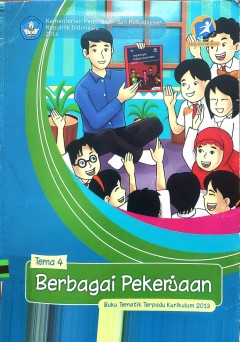
Tematik Terpadu Kurikulum 2013: Tema 4 Kelas IV – Berbagi Pekerjaan
Tematik Terpadu Kurikulum 2013 Theme 4 – Sharing Work is a thematic integrated textbook for Grade 4 Indonesian primary students. It explores collaboration, roles, and responsibilities in various jobs within the school and community context. The book integrates language, social studies, science, and arts through reading tasks, discussions, and project work. Designed according to the Indonesian…
- Edisi
- 2
- ISBN/ISSN
- 9786022821526
- Deskripsi Fisik
- 152 pages : illustrations ; 25 cm
- Judul Seri
- pages : illustrations ; 25 cm
- No. Panggil
- 372.19 AFR b c1
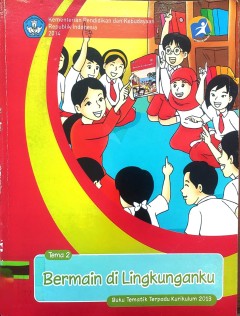
Tematik Terpadu Kurikulum 2013: Tema 2 Kelas I – Bermain di Lingkunganku
Tematik Terpadu Kurikulum 2013 Theme 2 – Playing in My Environment is an integrated thematic textbook for Grade 1 Indonesian primary students. The book explores children’s playing activities, cooperation, and social interaction within home, school, and neighborhood environments. Through reading, storytelling, physical activities, and collaborative tasks, learners build language, social, and…
- Edisi
- 1
- ISBN/ISSN
- 9786022821663
- Deskripsi Fisik
- 204 pages : illustrations ; 25 cm
- Judul Seri
- Tematik Terpadu Kurikulum 2013
- No. Panggil
- 372.19 TAU b c1

Tematik Terpadu Kurikulum 2013: Tema 1 Kelas IV– Indahnya Kebersamaan
Tematik Terpadu Kurikulum 2013 Theme 1 – Beautifulness of Togetherness is an integrated thematic textbook for Grade 4 Indonesian primary students. The book explores the value of living together in harmony within families, schools, and communities. Through thematic learning that combines language, civics, social studies, science, and arts, students engage in reading, discussion, writing, and c…
- Edisi
- 2
- ISBN/ISSN
- 9786022821472
- Deskripsi Fisik
- 106 pages : illustrations ; 25 cm
- Judul Seri
- Tematik Terpadu Kurikulum 2013
- No. Panggil
- 372.19 AFR i c1
 Karya Umum
 Filsafat
 Agama
 Ilmu-ilmu Sosial
 Bahasa
 Ilmu-ilmu Murni
 Ilmu-ilmu Terapan
 Kesenian, Hiburan, dan Olahraga
 Kesusastraan
 Geografi dan Sejarah